


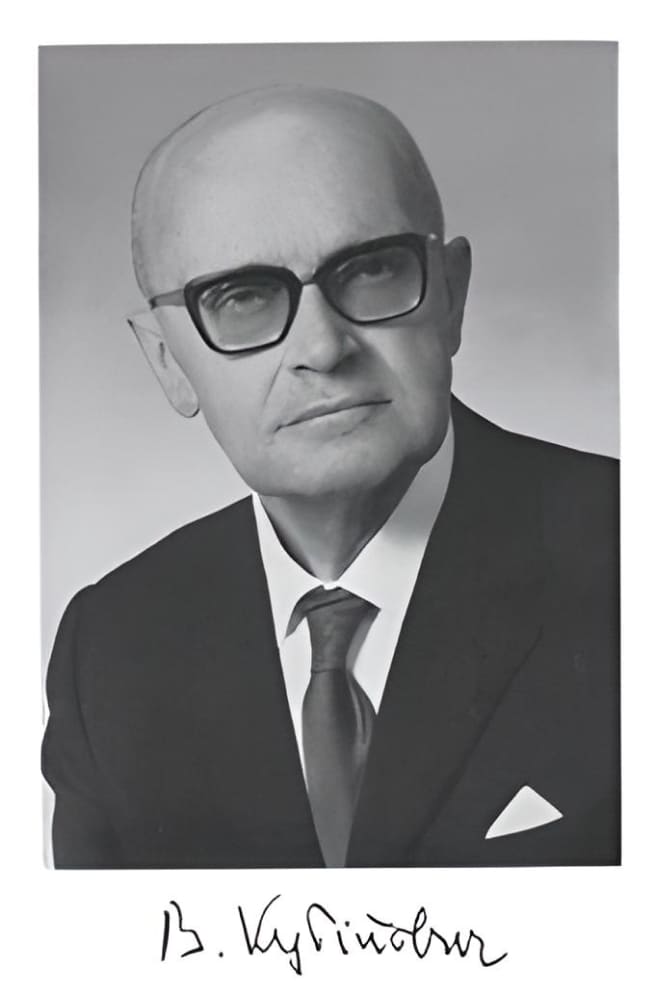
Volodymyr Kubijovyč. I am 70 years old. Shevchenko Scientific Society. Paris-Munich. 1970

Volodymyr Kubijovyč during a speech. 1940s-1950s. Central State Audiovisual and Electronic Archive

Most of my works had both scientific and political significance: my goal was to provide my own people and foreigners with information about the geography and population of Ukraine from an all-Ukrainian perspective.
Volodymyr Kubijovyč
Volodymyr Kubijovyč was a scholar, historian, geographer, encyclopedist, publisher, and public figure who made great efforts to create the Encyclopedia of Ukraine, the most significant scientific project of the Ukrainian diaspora.
He was born on September 23, 1900, in a Ukrainian-Polish family in the Lemko region in Nowy Sącz (Poland). He graduated from a people’s school and gymnasium there and entered the University of Krakow in 1918. In the same year, he became an artilleryman in the Ukrainian Galician Army. Eventually, he returned to his studies and wrote his thesis on “Gorgan Anthropogeography” at the Jagiellonian University (1923), later taught there (1928-1939) and in Krakow gymnasiums. He was the secretary of the Krakow branch of the Polish Geographical Society, a member of the Geographical Commission of the Polish Academy of Sciences (since 1923), a full member of the Shevchenko Scientific Society and the head of its geographical section (since 1931). He researched Ukrainian ethnic lands within the USSR, Poland, Czechoslovakia, and Romania. He defended Ukrainian geopolitical interests in publications and at international scientific congresses, which forced him to leave the Jagiellonian University.
From 1940, Volodymyr Kubijovyč was a professor at the Ukrainian Free University in Prague. At the same time, he collaborated with the OUN (Organization of Ukrainian nationalists) in establishing Ukrainian schools in the Lemko region. He headed the Ukrainian Central Committee in Krakow, which coordinated the activities of Ukrainian social and cultural organizations and helped Ukrainian refugees from the USSR. In April 1943, as chairman of the UCC (Ukrainian central committee), Kubijovyč became one of the organizers of the Military Administration and joined the formation of the SS Galician Division.
When the Polish-Ukrainian war broke out, he called for an end to the armed confrontation. He helped many Ukrainian political and public figures and Jews avoid Gestapo arrests. Since 1945, Kubijovyč had been the deputy head of the Ukrainian National Committee in Germany.
After World War II, he focused on scientific and organizational activities in Germany (since 1946) and France (since 1951). He taught at the Ukrainian Free University and initiated the creation of the Institute of Correspondence Studies in Munich and the revival of the Shevchenko Scientific Society (NTSh). From 1947 to 1951, he was the Secretary General of the NTSh, and from 1952, he was the Chairman of the NTSh in Europe and the Historical and Philosophical Section of the NTSh. He succeeded in uniting dozens of Ukrainian scholars in exile around the NTSh. He made a tremendous contribution to publishing its multi-volume edition, the Encyclopedia of Ukraine (Paris-New York, 1955-1984), of which he was the editor-in-chief.
Volodymyr Kubijovyč is the author of more than 80 scientific works on the geography and history of Ukraine, including Geography of Ukraine and Adjacent Lands, The Territory and Population of the Ukrainian Lands, Ethnographic Map of Southwestern Ukraine (Galicia), comprehensive geographical descriptions of all ethnic Ukrainian lands from Podlasie to Donetsk, and works on the history of Ukrainian emigration. In all of them, he substantiated the concept of the revival of the national state within its ethnic boundaries. In 1981, he became the first laureate of the Canadian Foundation for Ukrainian Studies.
Volodymyr Kubijovyč died on November 2, 1985, in Sarcelles, France. Streets in Ivano-Frankivsk, Lviv, and Kolomyia were named in his honor.
