Oksana Liaturynska. Prague. 1920s (?). UVAN archive

Oksana Liaturynska working on a bust of Taras Shevchenko for the Ukrainian Gymnasium in Rzhevytsia. Prague, 1935. UVAN archive

Harvest has come, and it shall come once more.
Black soil yields fruits forever sown.
The world, shaped by the potter’s hand,
Like flowers on the land
Oksana Liaturynska
Oksana Liaturynska was a writer, pysanka artist, sculptor, and representative of the Prague school.
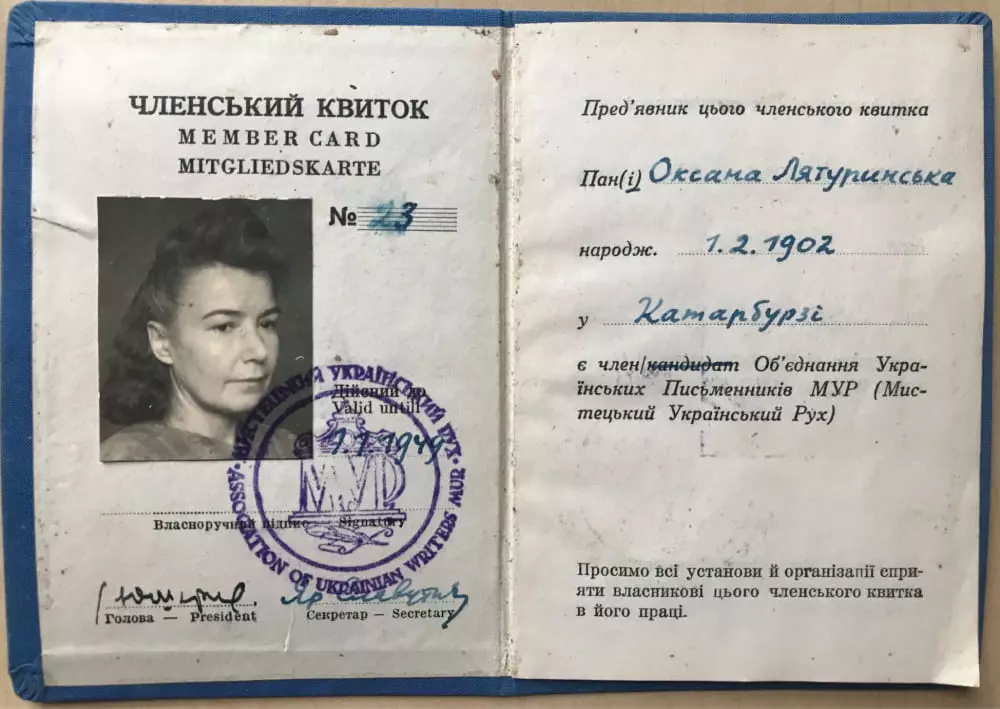
Oksana Liaturynska was born on February 1, 1902, in the Lisky, now a part of the village of Khomy in the Ternopil region. The name of the nearby town, Vyshnivets, which was situated nearby, influenced one of Oksana’s pseudonyms–Vyshnevetska (among her other pseudonyms: Oksana Cherlenivna, Marta Boretska, Roxolana Cherlenivna). She had German heritage on her mother’s side. Liaturynska studied at the Kremenets Private Ukrainian Gymnasium, named after Ivan Steshenko and a girls’ boarding school named after Count Dmytro Bludov.
In 1919, she moved to her brother in Germany to avoid an undesired marriage. Since 1924, she resided in Prague, where Oksana pursued her philosophical education at Charles University. At the same time, she attended the Ukrainian Studio of Plastic Art and the Czech High School of Art and Industry. She studied drawing and sculpture, leaning towards animal style and formal monumentalism.
In Prague, she actively participated in the Ukrainian immigrant community. She worked extensively on sculptural portraits, creating busts of Taras Shevchenko, Tomáš Masaryk, Symon Petliura, and a monument to the fallen soldiers of the Ukrainian People’s Republic in Pardubice (1932). At the request of the Ukrainian National Association, she made a tombstone for the grave of Colonel Yevhen Konovalets in Rotterdam. In addition, Liaturynska painted portraits of prominent diaspora figures for publication in newspapers and a series of paintings of historical figures called “Rulers of the Ukrainian State” for the personal American archive-museum of the priest of the Ukrainian Sich Riflemen of the UPR Army, Father Petro Bilon.
Liaturynska’s works were published in emigrant periodicals such as “Vistnyk” edited by Dmytro Dontsov, “Literary-Scientific Bulletin” and “Proboyem.” In 1941, she published her poetry book “Knyazha Emal” (Princely Enamel), dedicated to the memory of the poet Yurii Darahan. Poems were mainly written about the princely era and her native Volyn region.
During the years of World War II, Oksana lost a part of her artistic works, and in 1945, she was forced to leave Prague and relocate to Ashaffenburg, Germany, where she stayed in a displaced persons camp. There she joined the Artistic Ukrainian Movement (MUR), led by Ulas Samchuk. In 1949, Liaturynska immigrated to the United States and settled in Minneapolis. Due to health issues, she stopped working with ceramics and instead began creating pysanky, dolls and other decorative figures.
Oksana Liaturynska passed away on June 13, 1970, and was buried in the St. Andrew Ukrainian Orthodox Cemetery in South Bound Brook, New Jersey. Her grave is located opposite the grave of the writer Yevhen Malaniuk.